

Ask ten pool pros which software is the best and you will get ten different answers, all of them correct for the pool pro giving you them. That is a real feature of pool software, because the products differ less than the pricing models do.
Two numbers decide most of it, how many pools you service, and how many technicians you employ. Flat-priced platforms get cheaper per pool with every account you add. Per-pool and per-technician platforms get more expensive with every account and every hire.
Run those two numbers against six pricing structures and the field narrows before you have watched a single demo.
The second thing separating them is quieter, and it matters more. Almost nobody’s pool business stalls because the route map is ugly. Businesses stall somewhere between 300 and 500 pools, and the reason is usually the same:
One dispatcher.
One bookkeeper.
One owner.
The owner is usually the one answering customer texts at 9pm on a Sunday while rebuilding next week’s schedule around a technician who quit on Friday.
Every new truck adds administrative load faster than it adds margin, and at some point the office becomes the ceiling.
Some platforms on our list make that office work faster. A few take the work off your desk entirely. That is the real dividing line, and almost no comparison guide asks about it.
One note before you start. This guide is published by PoolProof and it ranks PoolProof first. Every price and capability below comes from the vendor’s own public pages as of August 2026, every platform gets a plain statement of where it beats PoolProof, and PoolProof’s own weaknesses are listed alongside everyone else’s. Verify anything that is going to cost you money.
Table of Contents:
Quick Verdict: Which Platform for Which Business
If you read one section, read this one. Here is the short version:
Key takeaway
Per-pool pricing is the better value below roughly 125 pools. Flat pricing is the better value above it. Everything else is a distant second consideration.
How Pool Software Platforms Were Compared
Pool software usually gets compared on feature checklists, which is close to useless. Every platform here can claim routing, invoicing, and chemical tracking. The word “routing” alone covers everything from a drag-and-drop list to a genuine optimization algorithm, and both get the same checkmark.
So the comparison below scores three things that actually move your P&L, plus pricing structure:
- Optimized routing vs just organized routing. Organizing means you drag stops into an order and the software remembers it. Optimizing means an algorithm computes the shortest viable sequence from service days, geography, job duration, and technician workload, then recomputes when the week changes. Most platforms do the first. Ask which one you are buying, and which tier it lives in.
- Native water chemistry, or a calculator in a separate app. A dosing engine that reads entered values, factors in CYA-adjusted chlorine targets and LSI, and writes quantities used back to the service record is the clearest line between pool-specific software and generic field service tools.
- Office labor eliminated, not just digitized. Digitizing a task means someone still does it, faster. Eliminating it means nobody does it. If your dispatcher spends four hours a week rebuilding routes around callouts, software that speeds that up saves two hours. Software that handles it saves four.
Comparing 6 Pool Software Companies
1. PoolProof: Best for operators who want the office work automated
Pricing: $249/mo billed annually ($2,988/year), or $299/mo month-to-month.
Users: Five users included, additional users $40/mo. No per-pool or per-stop fees.
Migration: Onboarding and data migration included.
Free trial: None. Every account is onboarded live, so evaluation happens through a demo.
Best for: 150 to 1,000+ pool operations where administrative labor, not route mileage, is the constraint.
Most pool software was built by pool operators solving their own problem with the tools available at the time, and the architecture tends to show it. PoolProof was built by software engineers who spent months interviewing operators first, then designed around the thing operators complained about most, which was never the route. It was the office.
The core of the product is Digital Team Members, and it is the clearest category difference in this guide. Rather than surfacing another dashboard for a human to act on, PoolProof runs persistent digital workers against live operational data.
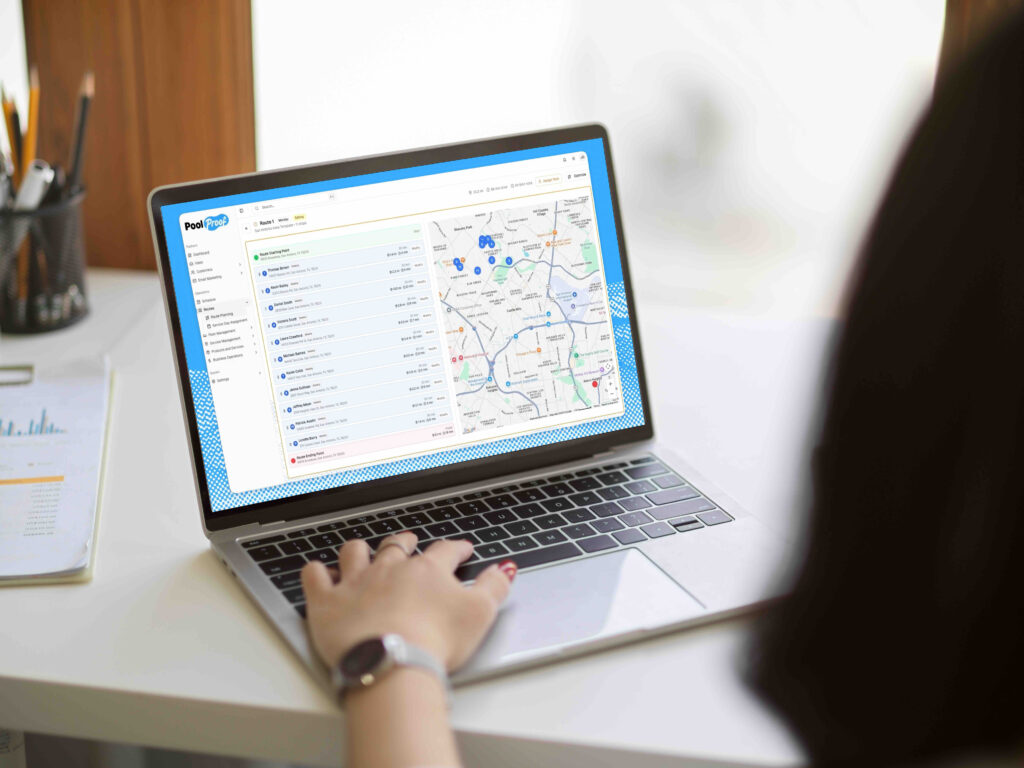
A Digital Dispatcher analyzes routes continuously, watches the weather, handles callouts, and rebalances workloads when the plan changes. A Service Agent handles inbound conversations across text, WhatsApp, and email around the clock, shows real availability from live routes, and books the visit.
A Collections Agent monitors receivables, sends escalating reminders, and flags problem accounts. The governing constraint is stated plainly inside the product: the software recommends, you decide.
Underneath that sits a multi-stage routing algorithm that re-analyzes weekly, a chemical dosing engine built on polynomial equations rather than a lookup table (adaptive chlorination scales the free chlorine target to CYA, and LSI is factored into every recommendation), one shared inbox for every channel, and a self-serve signup flow where a prospect validates their address, picks a plan, enrolls in autopay, and signs a service agreement at 10pm on a Sunday with nobody in the office. The customer portal is white-labeled on your own domain.
Where PoolProof may not be the right choice.
- Flat pricing is poor value below 125 pools. A 60-pool route pays $4.15 per pool per month while a 400-pool operation pays $0.62 for the same software. If you are small, buy a per-pool competitor.
- There is no free trial. If your buying process requires poking at software unsupervised for a week, that is friction, and it is fair to hold it against us.
- It is new. PoolProof launched in early 2026. Several platforms here have a decade of operators and hundreds of public reviews. If a long track record is a hard requirement, that is a legitimate reason to wait.
- Integrations are narrow. QuickBooks Online and Stripe. No QuickBooks Desktop, Xero, public API, or Zapier.
- Seats cost money above five. A 12-technician shop pays $529/mo, still flat with respect to pool count. Ask about volume pricing.
2. Skimmer: Best for first-time software buyers
Pricing: Per service location. From $49/mo for up to 49 locations; the growth tier starts around $98/mo plus roughly $2 per location.
Free trial: Yes, free to start, no demo required.
Skimmer is the incumbent and it earned the position: 30,000+ pool pros, a 4.9 Capterra rating across a couple hundred reviews, and by a wide margin the deepest public review base here.
Routing works in both web and mobile. Chemistry is strong, with real-time LSI and dosing recommendations.
Billing is mature, and the customer service report emails with photo evidence are a Skimmer signature that operators credit with killing the “did anyone come today?” calls. It also publishes named case studies with real operators, which is more customer proof than most of this list combined.
Where it stops.
Per-location pricing rises as you grow: Pricing rises as you grow your route and the rate moved from roughly $1 to $2 in 2024, so at 500 pools this becomes a four-figure monthly line item.
Hand-optimized routing: Routing is a tool your staff operates, so nobody is watching the week and rebalancing when a technician calls out.
Unified team inbox: There is no unified team inbox. Customer-facing surfaces carry Skimmer’s branding, including a portal on a Skimmer-owned domain.
Quoting additional services: Quoting is administrator-oriented, which makes it harder for a technician to close an add-on repair while standing at the equipment pad.
Key takeaway
The safest first purchase in the category. The open question is what happens at 400 pools, when per-pool pricing and manual office work start compounding at once.
3. Pool Brain: Best for chemistry-driven operators
Pricing: Roughly $55 per technician per month plus about $10 per office admin account, with unlimited office users. Effective entry around $60/mo.
Free trial: Demo-led.
Chemical dosing & calculators: Pool Brain is the most technically serious chemistry product in the category. Guided dosing auto-calculates additions the moment a technician enters readings, which structurally removes both under-treatment and over-treatment.
That matters more than it sounds: under-treatment generates callbacks you can see, and over-treatment burns margin you cannot, a few dollars at a time across every stop all season.
Integration with software: The integration list is the deepest here, covering Orenda with LSI, LaMotte Spin Touch import, WaterGuru, QuickBooks Online, and Heritage Pool Supply for ordering from the app. Route profitability reporting is genuinely useful and something most competitors bury.
Where it stops.
Per-technician pricing rises with hiring, so a 12-technician operation runs roughly $660/mo in seat costs before office users. There is no service area concept, so territory-driven pricing and assignment means exporting and slicing data yourself.
Issue tracking exists without automatic intake or a unified inbox. Documentation is photo-only. The customer portal sits on Pool Brain’s domain.
Key takeaway
Pool Brain reports beautifully on work that people still have to do.
4. Paythepoolman: Best for billing-first shops and integrated payroll
Pricing: $50/month base plus $15/month per technician, so $65/mo at one technician. Pool Junction branded customer app is a $25/mo add-on.
Free trial: Yes, 30 days.
The veteran of this list, with over ten years of iteration and no debt. The name tells the origin story: this started as billing and grew outward, and billing is still its strongest muscle.
Best for: Integrated payroll is the standout feature, because very few pool platforms actually run payroll and this one does, tied to a timeclock and GPS tracking.
Software integrations: Bank integrations import and auto-categorize expenses, which is closer to light accounting than most competitors attempt.
Additional features: Contactless bidding, one-click route optimization, and a free Orenda integration with Plus round it out.
Where it stops.
Support runs Monday to Friday, 8am to 4pm Eastern, which is a real constraint for a business working weekends in Arizona or California.
Per-technician pricing rises with headcount. Collections still depend on the office noticing, because the billing tooling is excellent but somebody has to read the aging report.
The interface shows its age. Add-ons stack, so total Pool Junction, text credits, payroll, and convenience fees before comparing against a flat-priced platform.
Key takeaway
Genuinely good software from people who have listened to pool pros for a decade, at the lowest monthly cost here.
5. Jobber: Best for mixed-trade companies
Pricing: Core from $49/mo (1 user). Connect $139 to $399/mo. Grow $199 to $499/mo. Plus $499 to $699/mo.
Free trial: Yes.
For home service pros: Jobber is the most mature platform here by an order of magnitude, with 400,000+ home service pros and 4.8 stars across nearly 14,000 App Store reviews. Its pool service page is one of eighteen industry pages it publishes, and that detail is the whole story.
Additional features: Quoting, scheduling, invoicing, and CRM are all excellent, and the integration ecosystem is the largest in this comparison, including Zapier with 2,000+ connections and a developer API.
Where it stops.
The limitation for a dedicated pool company is structural rather than a matter of polish.
No water chemistry engine: Jobber can document chemical usage as job details and custom fields, but it cannot guide dosing, calculate LSI, or scale chlorine targets to cyanuric acid, so your technicians will need a separate calculator and the reading, the calculation, and the record end up in three places.
No pool-specific data model: No bodies of water per property, no per-plan chemistry requirements, no filter-clean or salt-cell scheduling.
Key takeaway
The best general platform here for any home service business, and the one requiring the most assembly if pools are your only business.
6. POOL360 PoolService: Best for shops inside the POOLCORP supply chain
Pricing: First 60 days free, pricing thereafter arranged through POOLCORP.
Free trial: Yes, 60 days.
Produced by POOLCORP, the world’s largest wholesale distributor of pool supplies, and that parentage is the whole strategic story.
Product differentiation: The differentiating capability is that purchasing and operations live in the same ecosystem, with ordering and inventory wired into the platform you already transact with.
Additional features: The platform covers customers, orders, inventory, employees, and finances, with routing, quoting, invoicing, and mobile water testing.
Where it stops.
Distributor alignment cuts both ways, and software inside your largest supplier’s ecosystem is convenient right up until the day you want to shop your chemical spend.
Product execution is the recurring theme in independent reviews, which consistently flag bugs and signup friction. Pricing is opaque and not on a public page. There is no modern automation layer.
Key takeaway
You are buying the supply chain, not the software. If tighter ordering would not change your week, nothing else here will.
What It Actually Costs as You Grow
The most useful exercise before buying is running your own numbers against each pricing model, including where you expect to be in 24 months rather than only where you are now.
The shape is the whole argument. Flat pricing is a horizontal line. Per-pool pricing is a diagonal one, and the two cross at around 125 pools.
Three things fall out of this.
Per-pool pricing is the outlier at scale. Per-pool platforms cost three to four times more per month than everything else at 600 pools, purely because of structure. That is not a knock on the products. It is the reason growth-stage operators start shopping.
Paythepoolman is the cheapest platform here at every stage. If raw monthly cost is your deciding factor, that is your answer, weighed against weekday-only support hours.
Cheapest software is not the lowest total cost. A platform costing $170/mo that requires 15 hours a week of office labor is more expensive than one at $369/mo requiring four. At $25/hour of loaded admin cost, that is roughly $1,100 a month running the wrong direction.
Run the labor line, not just the license line. That is the entire argument for automation-first software, and it is also the reason a 60-pool operator should ignore that argument completely. At 60 pools, you are the office, and your marginal hour is cheap.
Why Pool Operators Make a Switch
“Better features” is not why anybody migrates. Migration is painful and expensive in attention, and people only do it when something structural breaks. Four things break.
The pricing model turns on you.
Every account you add, which is the thing you have spent years working toward, increases your software bill. When per-location pricing across the category moved from roughly $1 to $2 in 2024, the operators who felt it hardest were the ones who had grown the most. There is something structurally strange about a bill that punishes your best year.
The office becomes the bottleneck, not the route.
Somewhere between 200 and 400 pools, the constraint stops being windshield time and becomes administrative.
Routes rebuilt by hand every time somebody calls out. A rain day that costs the dispatcher an afternoon. An aging report nobody has opened in three weeks. Every platform here makes those tasks faster. Few remove them.
That distinction is what operators mean when they say software “does not scale.” The software works fine. Using it has quietly become a job, and that job now needs a person you did not budget for.
Customer conversations are trapped on individual phones.
Ask any owner running 300+ pools what happens when a technician quits. Somewhere in that person’s text messages is the gate code conversation, the “please do not service on Thursdays” agreement, the complaint that never became a ticket, and the verbal approval for a repair that is about to be disputed.
All of it walks out the door with the phone.
New revenue depends on somebody being available.
Homeowners shop for pool service at night and on weekends, and the business that answers first usually wins.
If your intake path is a phone call to a closed office or a web form read on Monday morning, you are losing jobs you already paid to generate.
Some platforms answer the phone with AI. Some let a prospect qualify their own address, pick a plan, pay, and sign at 10pm Sunday. Most simply let a customer request service, which is not the same thing as becoming a paying, autopay-enrolled customer.
How to Choose: Five Questions to Ask Yourself
1. Where will you be in 24 months?
Model your cost at your target pool count, not today’s. If you plan to double, per-pool pricing doubles right along with you. If you plan to stay comfortably solo, flat pricing is money you are lighting on fire.
2. Is your bottleneck miles, or office hours?
Ride along for a day, then sit in the office for a day. If windshield time is the problem, buy the best routing you can afford. If the office is drowning, routing quality is a second-order concern.
3. Do you need a native chemistry engine?
If water quality is your differentiator, or your technicians’ skill varies, guided dosing with automatic LSI is worth paying for and immediately rules out the generic field service platforms. For a repair-heavy shop, it matters far less.
4. Where does new business come from, and who is there to catch it?
If inbound calls and after-hours inquiries are your growth engine, prioritize automated answering or self-serve signup. If you grow entirely by referral, do not pay for either.
5. Can you get your data out?
Ask every vendor, in writing: what format, how fast, and at what cost do I get my complete customer, service history, and billing data if I leave? A vendor who answers cleanly is telling you how they intend to keep you.
Already decided and dreading the migration? We wrote a separate guide on switching pool software without losing a season.
The Bottom Line
Two numbers decide this: your pool count and your technician count. Run both against every pricing model at your 24-month target rather than today’s, and the field narrows fast.
Then answer one question honestly. Is your bottleneck the windshield, or the office?
If it is miles, buy the best routing you can afford at your size. For most operators under 150 pools, that means a per-pool platform with a free trial, and you should go start one this afternoon.
If it is the office, the Sunday night schedule rebuild, the aging report nobody reads, the customer texts landing on a technician’s personal phone, then the deciding question is not which platform tracks the work best. It is which one does the work.
PoolProof was built for the second answer.
Whether it is the right answer for you is a question arithmetic can settle faster than a sales call. So bring the numbers. Your pool count, your technician count, and an honest estimate of the hours your office loses every week to rebuild the schedule and chase payments. We will run them against what you pay today and show you exactly where the lines cross.
If the math says stay where you are, that is what we will tell you.
FAQs
What is the difference between route optimization and route management?
Route management means you organize stops yourself, usually drag-and-drop on a map, and the software remembers your order. Route optimization means an algorithm computes the most efficient sequence based on geography, service day, job duration, and technician capacity, then recomputes when conditions change. Both get marketed as “routing.” Ask which one you are buying and which tier it lives in.
How much does pool routing software cost in 2026?
Roughly $49/month for a solo operator to $1,200+/month for a 600-pool operation, depending far more on pricing model than on product quality. Per-pool platforms run about $2 per pool per month. Per-technician platforms run $15 to $55 per technician. Flat-priced platforms run $249 to $299/month including several users. Per-pool is cheapest under roughly 125 pools, and flat is cheapest above it.
Which pool routing software has the best route optimization?
PoolProof runs a multi-stage algorithm that groups by service day, clusters geographically, balances by duration, and consolidates undersized routes, then re-analyzes weekly while handling callouts and weather automatically. Skimmer, Pool Brain, and Paythepoolman all offer optimization that a person triggers and manages. Jobber generates fuel-efficient routes and assigns work to the nearest technician but has no pool-specific routing logic.
Can I use general field service software for a pool business?
Yes, and it works well if pools are one of several trades you run. The hard limitation is water chemistry. General platforms can record chemical usage and pool measurements as job details, but they cannot guide dosing, compute LSI, or scale chlorine targets to cyanuric acid. Dedicated pool companies end up running a separate chemistry tool alongside, which is a workflow you will get tired of.
What is LSI and why does it matter in pool software?
The Langelier Saturation Index measures whether water is scale-forming, balanced, or corrosive, based on pH, temperature, calcium hardness, total alkalinity, and total dissolved solids. It is the difference between water that is technically in range on each individual reading and water that is actually stable. Software that calculates LSI automatically on every reading, and factors it into the dosing recommendation rather than just displaying it, prevents the plaster damage and equipment scaling that turn into warranty arguments years later.